$49 Roadside Assistance Near Me in Lumberton, NC
Need roadside assistance in Lumberton right now? Request a verified local roadside or towing provider, 24 hours a day.
$49 roadside service. Typical ETA: 10–20 minutes, depending on location, traffic, weather, and provider availability.
Book from your phone, review provider information where available, and follow the job from request to completion.
Book the service you need
Choose a service to open booking with that option already selected.
Mobile roadside services
Learn what each service covers before you book.
Roadside help built around where you are in Lumberton
A roadside problem in Lumberton can happen in a travel lane, a parking garage, outside a home, or at the end of a workday. Those locations require different vehicles, tools, and arrival instructions. I Need Roadside starts with the vehicle's actual location and the problem you select, then sends the request to providers who can take that type of job. You do not need a membership or an annual plan to request help.
The first priority is a safe, accurate request. Enter the vehicle location rather than your home address, choose the closest service, and add details such as the vehicle year, make, model, color, parking level, direction of travel, or gate instructions. That information helps a provider decide whether the job is a jump start, tire service, recovery, or tow before driving toward you.
Traffic and access conditions in Lumberton can change through the day. If the vehicle is near moving traffic, in a garage, behind a gate, or somewhere without a standard street address, describe the position in the booking notes so the provider can find the correct approach.
Choose the right roadside service in Lumberton
The service cards above are quick ways to book. These summaries explain which option fits the problem before you choose.
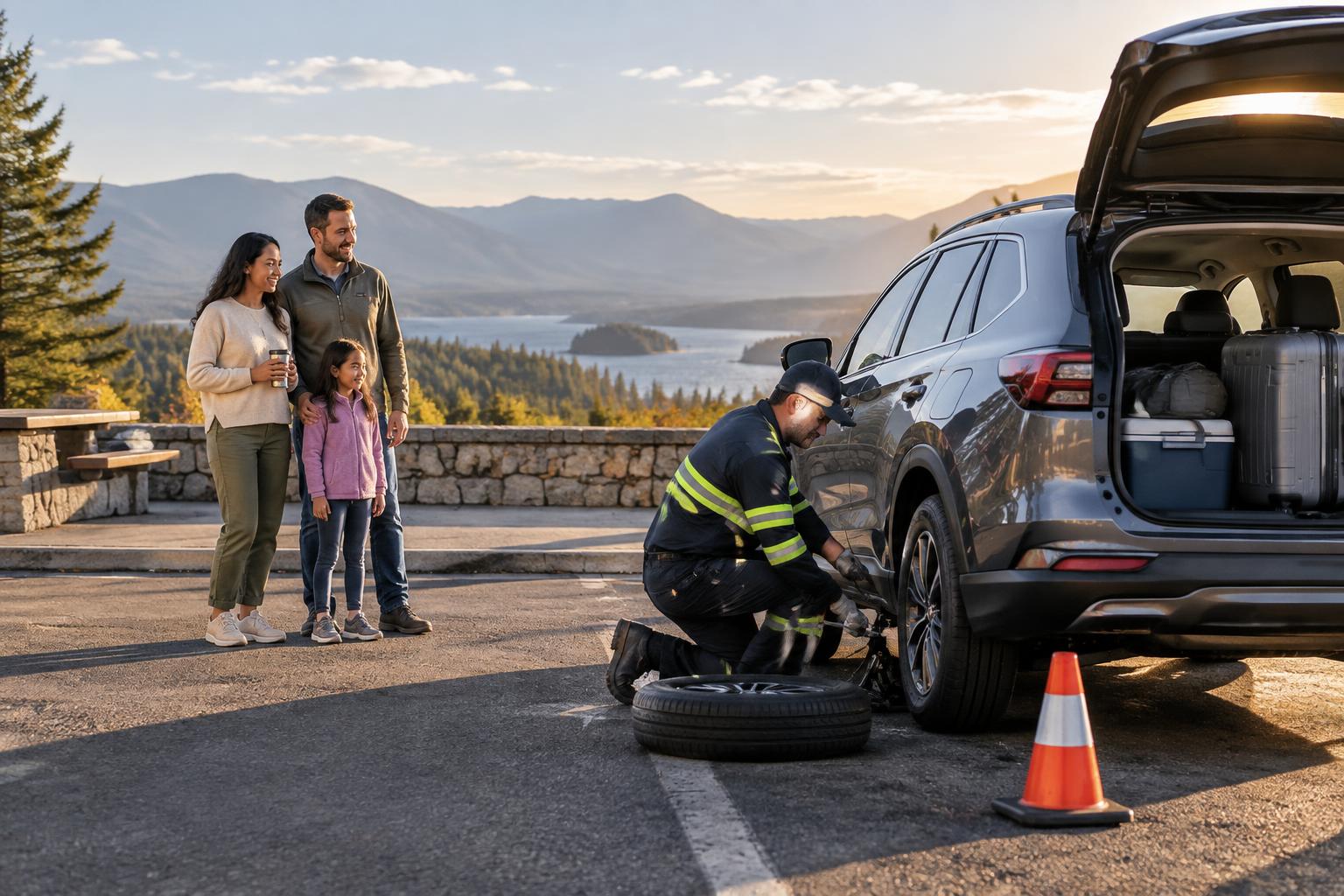
Choose a tire change when the vehicle has a safe, usable spare and the wheel can be reached on stable ground. Tell the provider where the spare and wheel-lock key are located.
A puncture in the repairable tread area may be plugged at the vehicle. Sidewall cuts, blowouts, exposed cords, and severely damaged tires are not safe repair candidates.
If there is no spare or the tire cannot be repaired, a matching replacement may be brought to the vehicle. Tire availability and the tire itself are confirmed separately.
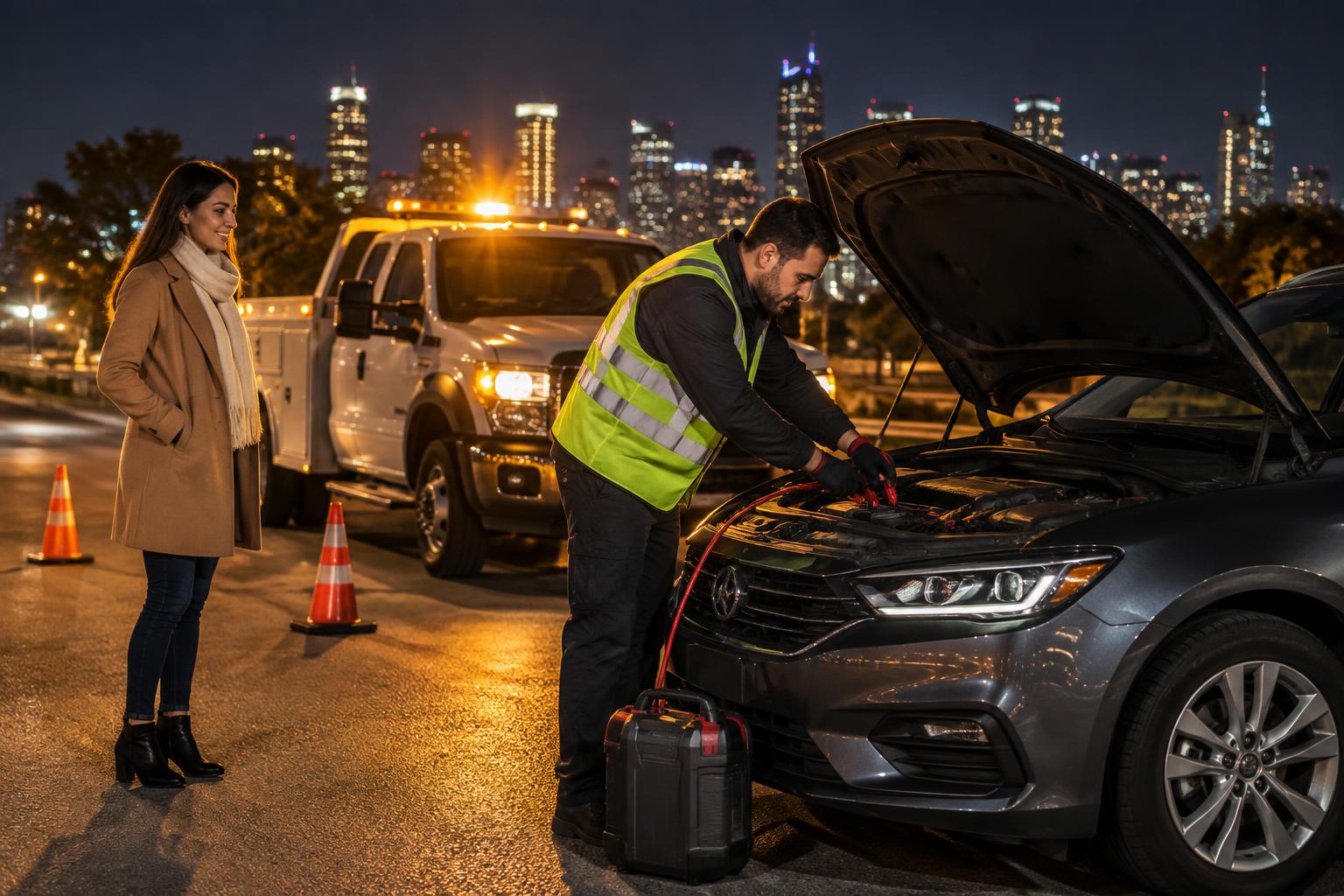
Choose a jump start for rapid clicking, slow cranking, or a vehicle that has lights but will not start. A successful jump does not repair a worn battery or charging-system fault.
Choose battery replacement when the battery is known to be worn out or repeatedly fails after a jump. The replacement battery is an additional product cost.
Lockout help is for keys inside the passenger cabin or trunk and similar access problems. Tell the provider the vehicle type and where the keys are visible, if known.
Fuel delivery brings enough supported fuel to help the vehicle reach a station. The fuel is an additional cost, and diesel or specialty-fuel needs should be stated clearly.
Choose this when a lug nut or wheel bolt is stripped, seized, locked, or will not move with the vehicle's tools. Describe any damaged key or adapter before dispatch.
Winch-out may help a vehicle stuck in supported mud, snow, grass, or a shallow roadside position. Deep recovery, rollover, water, or unsafe terrain may require specialized equipment.
Choose towing when the vehicle is unsafe to drive, cannot be repaired where it sits, has wheel or suspension damage, or must be moved to a shop or another destination.
Tire change service in Lumberton
A tire change uses the usable spare already carried in the vehicle. Before booking, check whether the car has a full-size spare, compact spare, or only an inflator kit. Many newer vehicles do not include a spare. If there is no usable spare, mobile tire repair or mobile tire replacement is usually the better request.
The work area matters as much as the tire. A provider needs stable ground, room to place a jack, and safe access to the damaged wheel. A traffic-side flat on a narrow shoulder, a steep slope, soft ground, or a wheel positioned against a curb may make an on-site tire change unsafe. In those situations the vehicle may need to be moved or towed first.
Have the wheel-lock key ready if the vehicle uses locking lug nuts. It may be in the glove box, center console, trunk tool tray, or spare-tire compartment. Mention a missing wheel-lock key, damaged lug, or previous unsuccessful removal attempt in the booking notes so the request is not treated as a routine tire change.
Mobile tire repair in Lumberton
A repair may be appropriate for a small puncture in the main tread when the tire still has usable tread and was not driven while fully flat. The provider must inspect the damage before deciding whether a roadside repair is safe. A visible nail does not guarantee that the tire can be repaired, and removing it before help arrives can make the leak faster.
Damage to the sidewall or shoulder of the tire, a large opening, exposed cords, a separated tread, or damage caused by driving on the rim calls for replacement rather than a plug. Multiple punctures or prior repairs near the new damage can also change the safe option. The goal is not merely to hold air in the parking space; it is to leave the vehicle with an appropriate next step.
When you request tire repair, report whether the tire is completely flat or leaking slowly, where the puncture appears to be, and whether the vehicle has been driven since pressure was lost. A clear photo can help the provider understand the job, but the final repair decision requires an in-person inspection.
Mobile tire replacement when there is no spare
A sidewall cut, blowout, failed inflator kit, or vehicle without a spare can leave replacement as the practical roadside option. Mobile tire replacement combines delivery and installation at the vehicle when a suitable tire is available. Enter the complete tire size from the sidewall, such as the width, aspect ratio, wheel diameter, and any load or speed rating shown.
Do not guess the size from the vehicle model alone. Trim levels and previous wheel changes can produce different sizes on otherwise similar vehicles. If the sidewall is damaged, read the size from another tire on the vehicle and note whether the front and rear sizes differ. The replacement tire cost is separate and should be confirmed before the provider brings it.
Some damage needs more than a tire. A bent wheel, broken suspension part, multiple damaged tires, or a vehicle resting on the rim may require towing. Describe impact damage and warning lights accurately so a provider does not arrive expecting a simple replacement when the vehicle cannot be safely driven afterward.
Stuck, stripped, or locked lug nuts
Lug nuts and wheel bolts can seize from corrosion, cross-threading, damaged caps, or excessive tightening during a previous service. Continuing with the vehicle's short factory wrench can round the fastener or break a wheel stud. Stuck lug help is a separate request because it calls for different tools and more time than a normal wheel change.
Tell the provider whether the fastener turns without loosening, will not move, has a rounded exterior, or uses a locking key that is missing or damaged. Also mention whether another person has already used an extractor, impact tool, or lubricant. That history changes which removal approach remains available.
Jump-start service in Lumberton
Rapid clicking, slow cranking, dim lights, or a vehicle that has been left with accessories running often point to low battery voltage. A jump start supplies enough power to attempt a start. Tell the provider exactly what happens when you press the start button or turn the key; “nothing,” “one click,” “rapid clicks,” and “cranks but will not fire” can describe different problems.
A jump start cannot fix every no-start. Bright lights with no crank may indicate a starter, switch, or security issue. An engine that cranks normally but does not start may have a fuel, ignition, or mechanical problem. If the vehicle starts and then dies again quickly, the charging system may need diagnosis. In those cases, towing may be safer than repeated jump attempts.
Batteries here get worked from both directions — summer heat wears them down and the first cold snap is often when the weakness finally shows up as a no-start. If the vehicle is in a garage, tell the provider the floor, clearance, and how close another vehicle can park. Portable jump equipment can often reach spaces that a tow truck cannot, but access details still matter.
Mobile battery replacement
Battery replacement is different from a jump start. It removes a failed battery and installs a compatible replacement when that service and battery are available. The provider may need the vehicle year, make, model, engine, and current battery information to identify a suitable product. The battery itself is priced separately from the roadside service.
A new battery does not solve a failed alternator, damaged cable, starter fault, or electrical drain. If the old battery repeatedly went dead, share that history. The provider can explain what is visible at the roadside, but a recurring electrical problem may still need diagnosis at a repair shop.
Car lockout assistance
Lockout requests commonly involve keys visible in the cabin, keys in a closed trunk, a vehicle running with the keys inside, or an electronic key that is not responding. Give the exact vehicle year, make, and model because entry methods and door construction differ. If a child, vulnerable person, or pet is in immediate danger inside, call 911 rather than waiting for ordinary roadside service.
Keep proof that you are authorized to access the vehicle available. Do not force the door, pry a window frame, or insert improvised tools while you wait; that can damage weather seals, wiring, airbags, glass, and locks. Tell the provider if the key is broken in a lock or ignition because that may require a different specialist.
Fuel delivery after running out of gas
Fuel delivery is intended to get a supported vehicle moving toward a nearby fuel station. Choose the correct fuel type and state clearly if the vehicle requires diesel or another special fuel. The delivered fuel is an additional cost. If the vehicle still will not start after fuel is added, the fuel system may need time to prime or the no-start may have another cause.
Do not walk along a highway or other high-speed road to look for a station. Turn on the hazards, move as far from traffic as the vehicle can safely roll, and request help from the vehicle or a protected area. If the fuel gauge is unreliable or the vehicle stopped with fuel still showing, mention that because the request may not be a simple out-of-fuel call.
Winch-out and vehicle recovery
A supported winch-out can help when a vehicle is stuck close to a firm driving surface in mud, snow, grass, or a shallow shoulder. Recovery depends on the vehicle's position, available anchor points, ground conditions, and the equipment of the responding provider. Photos and a precise description are especially useful for this service.
Do not keep spinning the tires while waiting. That can dig the vehicle deeper, overheat the transmission, and turn a simple pull into a more difficult recovery. Tell dispatch if the vehicle is leaning, in water, down an embankment, blocked by a fixed object, or damaged underneath. Complex recovery, rollover, flood, or hazardous locations may require specialized towing equipment or emergency services.
Towing in Lumberton
Towing is the right choice when the vehicle is unsafe to drive or cannot be made mobile where it sits. Common reasons include collision damage, wheel or suspension damage, overheating, repeated no-starts, multiple flat tires, a missing key, or a mechanical warning that makes continued driving risky. Enter both pickup and destination so the trip can be evaluated before dispatch.
Towing starts at $75 for the first 4 miles, then $19 per additional mile. The booking flow shows the applicable trip amount before payment. Tell the provider about all-wheel drive, low clearance, oversized vehicles, locked wheels, garage clearance, trailers, or modifications because those details affect the equipment needed.
You choose the destination. Confirm that the repair facility, dealer, residence, or storage location can receive the vehicle, especially after hours. A provider can move the vehicle, but cannot guarantee that a closed destination will accept keys or take responsibility for an unattended drop.
When roadside service becomes a tow
A roadside attempt should stop when continuing would risk the driver, provider, vehicle, or passing traffic.
- Unsafe work area
- A narrow traffic-side shoulder, blind curve, unstable surface, steep grade, or active travel lane can make on-site work unsafe.
- Damage beyond the selected service
- A bent wheel, broken suspension, leaking fluid, collision damage, smoke, fire, or severe overheating needs more than a jump or tire service.
- Vehicle still will not run
- If a safe jump start or simple roadside step does not restore operation, repeated attempts can create more damage.
- No safe repair is available
- A sidewall failure, multiple flats, missing special equipment, or unavailable replacement product may leave towing as the practical option.
How I Need Roadside works
The request stays connected to the vehicle, provider, status, and payment from booking through completion.
- 1Share the vehicle location
Use the current location or enter the exact address where the vehicle is stopped.
- 2Select the problem
Choose the closest service and add vehicle, access, safety, and equipment details.
- 3Review the request
See the applicable amount and confirm the information before payment and dispatch.
- 4Choose or receive a match
Where provider selection is available, review provider information or let the platform match the request.
- 5Follow the job
Use status and location updates from your phone. Typical ETA: 10–20 minutes, depending on location, traffic, weather, and provider availability.
- 6Confirm completion
When the work is complete, review the job and confirm that payment can be released.
How payment and job confirmation work
The booking flow shows the applicable service amount before you submit payment. Products such as a replacement tire, battery, or delivered fuel are separate when needed, and towing uses its own mileage-based price. You should know what you are approving before a provider brings a product or begins a changed scope of work.
Payment is handled through I Need Roadside rather than negotiated at the curb. The platform keeps the job record together with status updates and completion information. After the work is completed, the customer confirms the result and releases payment. If there is a genuine problem with the work, use the job's support or dispute controls instead of marking an incomplete job complete.
Never send an unexpected payment to a personal account because someone claims it is required to keep the request active. Keep communication and agreed charges attached to the job whenever possible so there is a clear record of what was requested and completed.
Using the nearby-provider map
The provider map helps you see available roadside and towing providers near the map area. Map positions and availability can change as providers drive, accept work, go offline, or complete another job. A visible provider is not a promise that a particular person will accept every service request.
Use “See Providers Nearby” to return to the map, set the relevant area, and review the information shown. The booking details still determine whether a provider has the right service and equipment. For example, a roadside helper who can perform a jump start may not operate a tow truck, and a tow provider may not carry a requested replacement tire.
Live status and provider tracking
After a provider accepts a request, available status and location updates let you follow progress from your phone. Keep the phone charged, notifications available, and contact information current. Watch the job rather than standing in traffic to look for an approaching vehicle.
Arrival estimates can change with traffic, weather, road closures, access problems, and the provider's starting position. Typical ETA: 10–20 minutes, but that is a typical estimate rather than a guarantee. If your location changes or a gate closes, update the provider promptly so they do not arrive at the original pin.
Where roadside requests happen in Lumberton
Confirm the house number, parking position, and whether the vehicle is in a driveway, alley, private garage, or curb space. Leave room beside the affected wheel when possible.
Include the company or building name only as a landmark, then add the lot entrance, row, level, or loading-area instructions needed to reach the vehicle.
Give the garage name, entrance, floor, section, space number, and posted clearance. Say whether the vehicle can shift to neutral and whether another car can park beside it.
Large lots may share one street address. Add the nearest entrance, store-facing row, light-pole number, or other visible marker without implying a business partnership.
Give direction of travel, the latest exit or mile marker, and the side of the roadway. Stay buckled inside when that is safer than standing on the shoulder.
Use the vehicle's actual location rather than a hotel or destination address. If you do not know the city, use the map pin and describe the road, direction, and visible signs.
Roadside help for rental cars and borrowed vehicles
You can request roadside help for a rental or borrowed vehicle when you are authorized to use it. Check the rental agreement before approving repairs, replacement products, or towing because the rental company may require a specific destination or process. Keep the agreement and identification available.
For a borrowed vehicle, confirm the tire size, spare location, wheel-lock key, fuel type, and any starting instructions with the owner when possible. If the vehicle must be towed, agree on the destination before booking so the provider is not left waiting for a decision at pickup.
Booking for a family member or another driver
A request can be placed for someone else. Use the stranded vehicle's location and details, not the booker's location. Put the driver's name and reachable phone number in the notes, and make sure the driver knows the provider's name, vehicle information, and expected service.
The person with the vehicle should understand what was booked and be able to provide access. If a parent is arranging help for a young driver, stay available by phone while the driver remains somewhere safe. For medical danger, a collision with injuries, fire, or an exposed vehicle creating an immediate traffic hazard, contact emergency services first.
Information to have ready before booking
A complete request reduces avoidable calls and helps the provider bring the right equipment.
- •Exact vehicle location, including direction of travel, parking level, gate, lot, or space details
- •Vehicle year, make, model, color, and plate when available
- •A plain description of what happened and what the vehicle does now
- •Tire size, spare availability, wheel-lock key, or visible tire damage for a tire request
- •Pickup and confirmed destination for a tow
- •Clearance, access, all-wheel drive, low ground clearance, locked wheels, or modifications
- •A charged phone and the contact number for the person waiting with the vehicle
Photos can clarify damage, vehicle position, and access. Take them only from a protected location and never step into traffic for a better angle.
What to do while you wait
- •Turn on hazard lights and move as far from active traffic as the vehicle can safely travel.
- •On a high-speed road, staying buckled inside is often safer than standing beside the vehicle.
- •If you must exit because of fire, smoke, or another immediate danger, use the side away from traffic and move well beyond the roadway.
- •Keep children and pets secured and do not allow anyone to wait between vehicles or near a travel lane.
- •Keep the phone available for provider messages and watch the job status instead of walking along the road.
- •Do not attempt a tire change, fuel walk, or inspection where traffic, weather, darkness, or unstable ground makes it unsafe.
Weather here can change quickly. Keep your hazards on, stay buckled in the vehicle while traffic is moving, and step out only on the side away from traffic.
Electric vehicles and hybrids
Electric vehicles and hybrids still use a low-voltage battery for computers, locks, and startup systems, so some no-start conditions may respond to an appropriate 12-volt jump. Tell the provider that the vehicle is electric or hybrid and give the exact model. Do not improvise connections to the high-voltage system.
A depleted high-voltage traction battery is not the same as a dead 12-volt battery. It may require towing to a compatible charging location. EV towing procedures vary, and some vehicles require a flatbed or a specific transport mode to prevent drivetrain damage. Follow the vehicle manual and give the provider any dashboard warnings before movement.
A flat tire on an EV can also require special attention because the vehicle may be heavier and may not carry a spare. Report the tire size, whether the car can roll, and whether the lifting points or suspension have visible damage.
Common roadside problems in Lumberton
Seasonal pavement damage and pressure swings both play a role here, so slow leaks and pothole damage are common through the year. Batteries here get worked from both directions — summer heat wears them down and the first cold snap is often when the weakness finally shows up as a no-start.
- Vehicle clicks but will not start
- Start with a jump-start request when the symptoms point to low voltage; use towing if the vehicle cranks normally or remains disabled after a safe attempt.
- Flat tire with a spare
- Choose tire change and report the spare type, wheel-lock key, surface, and position of the damaged wheel.
- Flat tire without a spare
- Choose mobile tire repair for a likely repairable tread puncture or mobile tire replacement for sidewall damage, a blowout, or no repairable tire.
- Vehicle will not move safely
- Choose towing for collision, wheel, suspension, overheating, multiple-flat, or mechanical situations that should not be driven.
- Keys or fuel unavailable
- Choose car lockout or fuel delivery and provide the specific vehicle and fuel details before dispatch.
Local access and driving conditions in Lumberton
Real requests happen in ordinary places: an apartment or residential parking lot where the vehicle sat overnight; a workplace or office-district lot at the end of a shift; a parking garage where the vehicle is on an upper level; a highway shoulder or on-ramp during commuting hours. The same mechanical problem can require a different approach in each location because a provider needs enough space to work and a legal, safe way to reach the vehicle.
Without a verified road name, the safest way to describe a roadside position is the exact map pin plus direction of travel, the nearest confirmed exit or intersection, and the side of the road. That is more useful than guessing at a local landmark.
The service listing for Lumberton includes verified in-city coverage data for areas such as North Lumberton. Availability still depends on the providers online when the request is made.
Why drivers use I Need Roadside
I Need Roadside is an on-demand marketplace rather than a membership club. Drivers request the service they need for the current problem, see the applicable amount before paying, and keep the request, provider status, and completion record together on the phone.
Provider information and matching options are shown where available. The job flow is designed to reduce uncertainty: the provider receives the vehicle details and location, the customer can follow available updates, and payment stays connected to the recorded job instead of becoming an untracked roadside negotiation.
That does not mean every roadside problem can be fixed in place or every provider is always available. Weather, traffic, equipment, product availability, vehicle condition, and work-area safety still determine what can happen. The value is a clearer way to request, track, and document the right response.
Roadside guides and safety information
Use these guides to understand the problem and stay safe while help is on the way.
More roadside pages for Lumberton
Lumberton, NC roadside assistance FAQ
How much is roadside assistance in Lumberton?
Supported roadside services are $49. Products such as tires, batteries, and fuel are separate when needed. Towing is priced separately based on trip distance, and the applicable amount is shown before payment.
How fast can a provider arrive?
Typical roadside ETA is 10–20 minutes, depending on your location, traffic, weather, access, and provider availability. It is an estimate, not a guaranteed arrival window.
Can I choose my provider?
Where provider selection is available, you can review available provider information and choose, or use automatic matching. Availability and service capabilities vary by request.
Is service available 24 hours in Lumberton?
I Need Roadside accepts requests 24 hours a day. Actual provider availability varies by location, time, traffic, weather, and demand.
How much is towing?
$75 covers the first 4 miles, then $19 per additional mile. Enter the pickup point and destination to see the applicable amount before booking.
When do I pay?
Payment is handled during the I Need Roadside booking process. After the service is completed, you confirm the work and release payment. Use the job's support controls if the work is incomplete or disputed.
Can a provider bring a replacement tire?
Mobile tire replacement may be available when you provide the correct tire size and a compatible tire can be sourced. The replacement tire is an additional cost that should be confirmed before delivery.
What if I do not have a spare tire?
Choose mobile tire repair if the damage appears to be a repairable tread puncture, or mobile tire replacement for a blowout, sidewall damage, or an unrepairable tire. Wheel or suspension damage may require towing.
Can roadside service replace my battery?
Battery replacement may be available when a compatible battery can be sourced. The battery is an additional product cost. Electrical or charging-system faults may still require shop diagnosis or towing.
Can I get help in a parking garage?
Often, but provide the garage entrance, floor, section, space, and clearance. Portable roadside equipment may reach places a tow truck cannot; towing from a low-clearance structure may require specialized equipment.
What should I do if I am stopped on a highway?
Turn on hazards, move as far from traffic as possible, and stay buckled inside when that is safer than standing on the shoulder. Give direction of travel, the last exit or mile marker, and the side of the road. Call 911 for immediate danger.
Does roadside assistance cover an electric vehicle?
Some EV problems, including certain 12-volt battery issues and tire requests, can be handled roadside. A depleted traction battery or vehicle-specific transport requirement may need an appropriate tow.
Do I need to be with my vehicle?
Someone should be with the vehicle when the provider arrives so access and completion can be confirmed.
Can I request service for a family member?
Yes. Enter the family member's vehicle location and details, include their contact information in the notes, and make sure someone is with the vehicle.
What payment methods are accepted?
Payment is handled securely during checkout. Where offered and approved, eligible customers may use supported flexible-payment options such as Klarna or Afterpay.
What if roadside service cannot fix the problem?
If the vehicle cannot be made safe to drive where it sits, towing may be the appropriate next step. The provider can explain what they found, but the driver decides where the vehicle goes.
Can I see who is coming?
Where provider information is available, you can review it before choosing and follow the assigned provider's status from your phone.
Need roadside assistance in Lumberton?
Request $49 roadside service or a tow from your phone and follow your provider in real time.