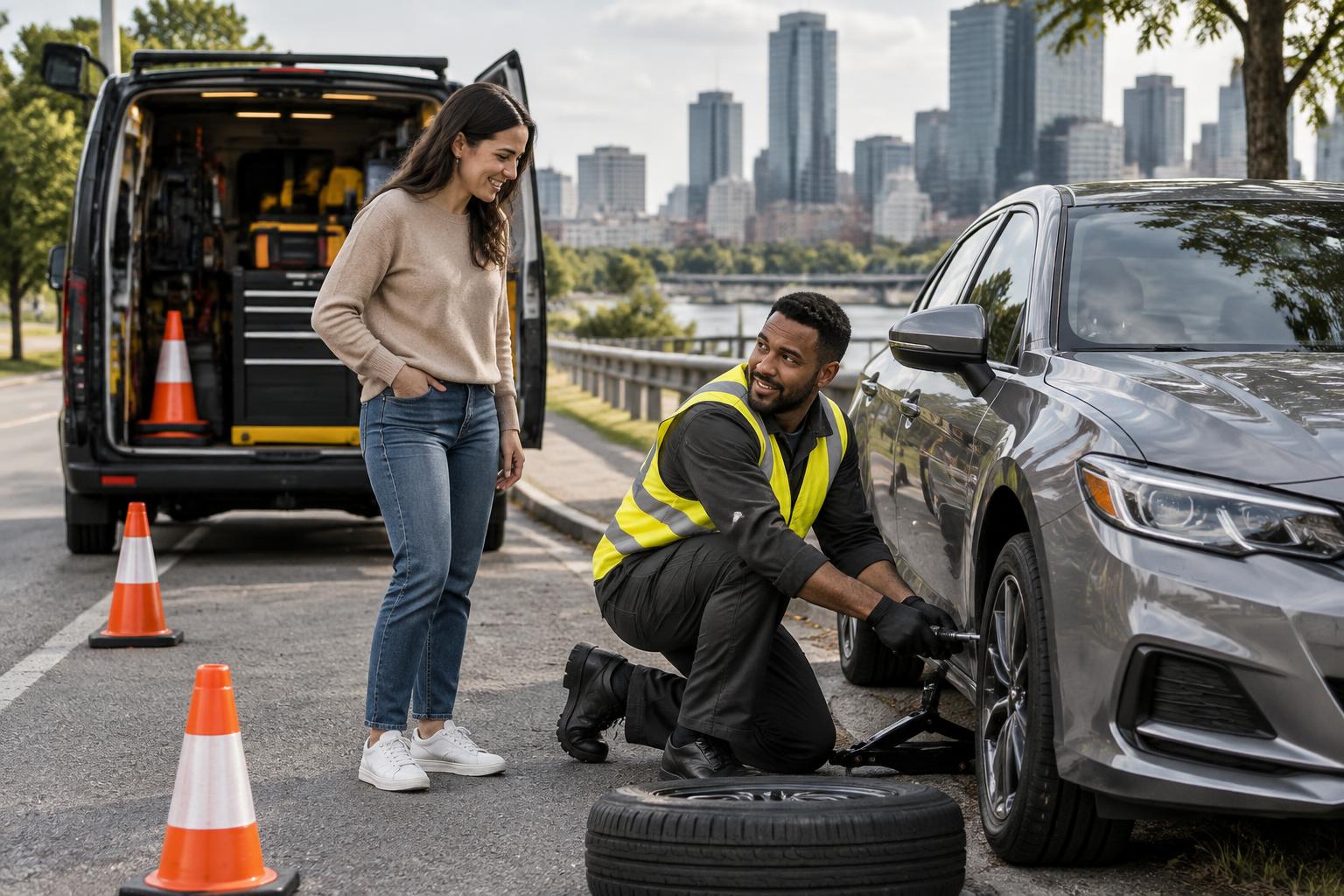


Mobile Tire Replacement in Philadelphia, PA
Need a tire brought to your vehicle in Philadelphia? Request mobile tire replacement for a damaged tire that cannot stay in service or a flat with no usable spare. An available provider can install an appropriate replacement at the vehicle when tire sourcing and safe access allow.
Enter the tire size when you know it, add vehicle details and photos, and review any separate tire quote before the tire purchase. Roadside service starts at $49; the physical replacement tire is separate. Typical ETA: 10–20 minutes, with sourcing, traffic, weather, location, and provider availability affecting actual timing.
Book the service you need
Choose a service to open booking with that option already selected.
Mobile roadside services
Learn what each service covers before you book.
When a replacement tire is the right request
Mobile tire replacement is for a driver who needs an actual tire brought to the vehicle, not simply air, a plug, or help installing a spare already in the trunk. It can be the right request when a tire is shredded, the sidewall is damaged, the wheel has been driven on while flat, or there is no usable spare available. The purpose is to solve the tire problem where the vehicle is parked when an appropriate tire and equipped provider are available.
A replacement is not automatically necessary for every flat. A small puncture in a repairable tread area may be suitable for mobile tire repair, while a driver with a properly inflated spare may only need a spare tire change. If you are unsure, describe what happened and add clear photos during the request. The provider can assess the visible condition, but no online description can promise that a particular tire is repairable before it is inspected.
Replacement, repair, or spare installation?
Choosing the closest match helps dispatch understand what the vehicle needs. You can explain uncertainty in the request instead of guessing.
- Mobile tire replacement
- Choose this when the existing tire appears beyond repair or you do not have another usable tire or spare to install. Tire availability and the replacement tire quote are separate from the roadside service request.
- Mobile tire repair
- Consider this for a nail, screw, or small tread-area puncture that may support a safe repair. Sidewall, shoulder, large, or structural damage commonly requires a different solution.
- Spare tire change
- Choose this when your vehicle already carries a usable spare and you need the damaged wheel removed and that spare installed.
- Towing
- A tow may be appropriate when the wheel, suspension, steering, or vehicle body is damaged, the vehicle cannot be serviced safely at its location, or a suitable tire cannot be obtained.
Find the tire information before booking
The clearest starting point is the size printed on the sidewall of the tire currently on the vehicle. A size commonly looks like 225/55R17, although your vehicle may use a different format.
- •Take one straight, well-lit photo of the complete sidewall size rather than typing from memory.
- •Add the vehicle year, make, and model so the request contains a second way to check fitment.
- •Say how many tires need attention and whether the damage is on the front or rear axle.
- •Mention whether the vehicle has a spare, a tire-repair kit, or neither.
- •Include a photo of the damage when it is safe to stand near the tire and take one.
- •Say whether you have a preference for a new or used tire; either option depends on current availability.
If you cannot read the size safely, select the unsure option and provide the vehicle details. Do not stand in traffic or kneel beside a traffic-facing wheel just to obtain a photograph.
How replacement tire availability works
A mobile replacement request involves two separate things: roadside installation service and the physical tire. The tire must be appropriate for the vehicle and available from the participating supply options at the time of the request. Less common sizes, specialty vehicles, performance fitments, and multiple matching tires can take longer to source or may not be available roadside.
Where new and used choices are available, the applicable option and tire price should be presented for review before the tire purchase is finalized. Tire cost is separate from the roadside service amount. Do not assume a tire has been reserved merely because the initial request was submitted; follow the quote and job updates shown in the booking and tracking experience.
How a Philadelphia mobile tire replacement request works
The request uses the same customer booking, dispatch, payment, and tracking journey as other I Need Roadside services.
- 1Choose Mobile Tire Replacement
Start the request with the replacement service selected rather than tire repair or spare installation.
- 2Pin the vehicle accurately
Enter the address or use device location, then add the level, space, block, or access note that distinguishes the vehicle.
- 3Provide tire and vehicle details
Add the size when known, vehicle information, photos, quantity, and any available new-or-used preference.
- 4Review the amounts shown
The roadside service and any separate replacement tire amount are presented through the applicable booking or quote step before the corresponding purchase.
- 5Follow dispatch
After a provider accepts or is assigned, use the job updates and available map tracking. Typical ETA: 10–20 minutes; actual timing also depends on tire sourcing, traffic, weather, and access.
- 6Confirm completion
Review the completed work, then use the customer job screen to confirm completion and release funds under the app's normal payment process.
Philadelphia street, garage, and highway access
A useful location note is more specific than “Philadelphia.” In Center City or University City, include the garage name or address, level, space number, clearance restrictions you know about, and whether an attendant can provide access. On a row-home block, describe the side of the street, nearby cross street, vehicle color, and whether another vehicle is blocking access to the affected wheel. These details help the provider understand the working space before arrival.
On I-95, I-76, I-676, Roosevelt Boulevard, or another high-speed road, the direction of travel and nearest exit or landmark matter. Shoulder space can be limited, and a safe roadside service location may not be available where the vehicle first stops. Follow instructions from emergency personnel when they are present. Do not attempt to move a disabled vehicle across live lanes to improve access.
Philadelphia's freeze-thaw cycles, broken pavement, construction plates, curbs, and road debris can all contribute to tire and wheel problems. Those conditions do not establish what is wrong with your tire. They are useful context to include alongside what you heard, whether pressure dropped suddenly, and whether the vehicle was driven after the tire went flat.
Damage that should be described clearly
The words and photos in the request help avoid arriving with the wrong expectation. Mention any of the following that apply:
- •A visible puncture in the tread, including whether the nail or screw remains in place.
- •A cut, bubble, gouge, or separation on the sidewall.
- •A rapid blowout, a slow overnight leak, or repeated low-pressure warnings.
- •A bent, cracked, or visibly distorted wheel rather than tire damage alone.
- •A wheel that cannot be removed because of a missing wheel-lock key or damaged lug hardware.
- •Vibration, steering pull, grinding, or another symptom that could indicate more than a flat tire.
A replacement tire does not correct suspension, steering, brake, or wheel-bearing problems. If those systems may be damaged, towing to a repair facility can be the more appropriate request.
New and used tire considerations
- New tire
- A new tire provides unused tread when the correct size and specification are available. Ask about the exact option shown in the quote rather than assuming a brand or model.
- Used tire
- Where offered, a used option should be reviewed for its stated condition and suitability. Availability is inventory-dependent, and the customer should see the applicable quote before purchase.
- Matching tires
- Vehicle handling and some drivetrains can be sensitive to differences in tire size, tread depth, or type. Provide accurate vehicle details and ask about the vehicle manufacturer's requirements when more than one tire differs significantly.
- Temporary mobility
- A roadside replacement addresses the tire itself. Any vibration, warning light, alignment concern, or handling issue after installation deserves prompt professional evaluation.
Tire-pressure monitoring and what happens after installation
Many vehicles use a tire-pressure monitoring system, often called TPMS, to warn about pressure changes. A warning light may not turn off immediately after a tire is installed. Some vehicles require driving or a specific relearn procedure, while a damaged sensor may need separate service. Mobile tire replacement should not be interpreted as a promise to repair or program every TPMS sensor.
After service, follow the provider's instructions and the vehicle manufacturer's guidance. Check that the vehicle feels stable before continuing a longer trip. If the tire-pressure warning remains, the steering pulls, or vibration develops, stop driving when safe and arrange further inspection rather than assuming the new tire alone will resolve the issue.
Make personal safety the first decision
Turn on hazard lights when appropriate and move away from traffic only when it is safe to do so. Do not place a jack, inspect a wheel, or wait beside the traffic-facing side of a vehicle in an unsafe location. If a child, pet, or anyone else is in immediate danger, call 911. A roadside request is not a substitute for emergency services.
What the customer pays for
The service and physical tire are different parts of this request.
Review the full customer total shown at checkout before paying. Do not treat the roadside service amount as a quote for the physical replacement tire.
Reading the sidewall without guessing at fitment
The three groups in a size such as 225/55R17 describe the nominal section width, aspect ratio, and wheel diameter. Load and service information may appear nearby, and some vehicles also have manufacturer-specific markings. A tire that shares only the wheel diameter is not necessarily the correct replacement. Sending the entire sidewall in focus is more useful than copying just the numbers you recognize.
Check the sidewall of the damaged tire and, when safely accessible, another tire already on the same vehicle. If they differ, include both photographs and explain which position each tire occupies. Do not rely on a tire size from an old online listing, a different trim level, or a wheel that was changed by a previous owner. The door-jamb label can provide vehicle information, but currently installed aftermarket wheels may use a different size from the original equipment.
Photographs support the sourcing conversation; they do not replace a fitment check. If the available option differs from what is currently installed, ask about that difference before approving the tire quote. A provider should not guess at an incompatible size simply to complete a mobile appointment.
Replacing one tire or addressing a set
- One damaged tire
- A single replacement may be appropriate when the remaining tires and vehicle requirements allow it. Tread depth, tire type, axle position, and drivetrain guidance can affect that decision.
- Two tires on one axle
- Some situations call for a closer match across an axle. State how many tires are damaged and whether you are asking about a pair; do not assume a single-tire quote covers two.
- All-wheel-drive vehicles
- Manufacturer limits on circumference and tread differences can be especially important. Provide the exact vehicle details and ask about its requirements before choosing an unmatched option.
- Multiple damaged wheels
- A mobile request may not be practical when several tires or wheels are affected. Towing to a facility with inventory and inspection equipment may be the safer route.
Special vehicles and equipment deserve an explicit note
Mention run-flat tires, low-profile fitments, oversized aftermarket wheels, dual rear wheels, loaded work vans, trailers, and accessible-vehicle equipment when they apply. These details can affect sourcing, jacking, torque procedures, and whether a participating provider has the necessary equipment. A standard passenger-car request should not be used as a catch-all for a vehicle with substantially different requirements.
Electric vehicles and hybrids still need correct tire fitment and safe lifting procedures. Tell the provider the exact model and do not place a jack beneath a battery pack or an unapproved lifting point. If the vehicle has a manufacturer-supplied mobility kit instead of a spare, include that information even when you believe the damaged tire is beyond what the kit can handle.
A tire-pressure sensor, wheel lock, or damaged lug nut can add a separate problem to the appointment. None should be discovered only because important notes were omitted. The goal is not to diagnose the entire vehicle online; it is to make the actual conditions visible before equipment and a tire are brought to the scene.
What happens if the requested tire is unavailable
Inventory can change while a replacement is being sourced. Keep the request and decision-making connected through the app rather than assuming an unquoted substitute.
- 1Check the request details
Confirm that the size, vehicle, quantity, and photographs were submitted accurately before evaluating alternatives.
- 2Review the available option
When another tire is offered, review its size, condition, and quoted amount rather than treating every same-diameter tire as equivalent.
- 3Ask about the next step
If the appropriate tire cannot be obtained, use the job communication and dispatch options to discuss whether waiting or towing makes sense.
- 4Use the applicable cancellation policy
If the requested service cannot be fulfilled, follow the customer job screen and published cancellation or refund terms rather than paying for an unauthorized substitution.
Prepare the vehicle and work area when safe
A few practical steps can make the appointment easier without putting you near a dangerous wheel or traffic lane:
- •Turn on hazard lights where appropriate and apply the parking brake on a stable, parked vehicle.
- •Remove personal belongings from the trunk or cargo area only if they block access to tools or the spare and it is safe to reach them.
- •Locate the wheel-lock key and tell the provider where it is, but do not attempt to loosen damaged hardware yourself.
- •Keep children, pets, and passengers in a safe waiting place away from the work area.
- •Move another vehicle that blocks access only if you can do so legally and without driving on the damaged tire.
- •Keep your phone available for access instructions, tire-quote updates, and the provider's arrival.
Weather and road conditions can change the appointment
Rain, snow, ice, extreme heat, and poor visibility affect both driving and the safety of working around a wheel. A provider may need a more protected position or may determine that the vehicle should be moved by a tow rather than serviced where it stopped. This is a safety decision, not a reason to pressure the provider into working beside live traffic.
After a pothole impact during cold or wet conditions, inspect only from a safe position and report any wheel damage or second flat. After driving through debris, avoid continuing at speed on an underinflated tire merely to reach a more convenient address. The condition of the tire and the safety of the stopping location should guide the next action, not the desire to keep an appointment or complete a trip.
Review the tire quote as a separate decision
The initial roadside request establishes that you need mobile service; it does not tell you every physical tire available at that moment. When a replacement option is located, read the quoted description carefully. Check the size, quantity, whether the option is new or used, and the tire amount before agreeing. If any part is unclear, ask through the available job communication channel rather than assuming that a substitute matches your request.
A quote for one tire should not be mistaken for a pair or a full set. Likewise, an available tire does not by itself commit you to unrelated wheel, alignment, sensor, or suspension work. Additional vehicle problems need their own assessment and applicable approval. Keeping the service, tire, and any other proposed work distinct helps you understand exactly what you are buying.
If the offered tire is not acceptable, use the customer job process to discuss alternatives or the applicable cancellation terms. Do not feel obligated to approve an unsuitable option merely because a provider has arrived. The record in the app gives both sides a clearer account of what was requested, what became available, and which amount was accepted.
Related Philadelphia tire and roadside services
Philadelphia provider network & service mix
78 independent provider profiles currently list Philadelphia as a service area. 1 provider currently has a recent live location update. Availability changes as providers go online and offline, so submitting a request is the way to confirm a match.
The services most commonly listed by these providers are Jump Start (78 providers), Tire Change (74 providers), Fuel Delivery (70 providers), Battery Replacement (62 providers), Car Lockout (60 providers). Offerings differ by provider, so your selected service, vehicle details, and location help dispatch identify an appropriate match.
Provider totals use profiles that explicitly list this city. “Recent live location” means an update within the last 15 minutes. Updated Nov 23, 2026, 10:17 AM UTC.
Philadelphia mobile tire replacement FAQ
Can you bring a tire if I do not have a spare?
That is the purpose of mobile tire replacement. Availability depends on obtaining an appropriate tire and matching the request with an equipped provider. The tire quote is separate from roadside service.
Where do I find my tire size?
Look for the size molded into the tire sidewall. It often resembles 225/55R17. Add a clear photo when safe, or provide the vehicle year, make, and model if you cannot read it.
Does the roadside service price include the tire?
No. The physical replacement tire is separate from the roadside service amount. Review the applicable tire quote and the full purchase amount before completing the corresponding payment.
Can every flat tire be replaced at the roadside?
Not every situation is suitable. Unsafe access, unavailable inventory, major wheel or suspension damage, and some vehicle requirements can make towing or shop service necessary.
Can I request a used tire?
You can state a new-or-used preference where the booking flow offers it. The available options and prices depend on current supply; a preference is not a guarantee of inventory.
Can you replace a tire in a Center City parking garage?
It may be possible when the provider can reach the vehicle and work safely. Include the garage address, level, space, and access instructions in the request.
What if my wheel is bent too?
A tire installation does not repair a bent or cracked wheel. Include a photo and describe vibration or handling symptoms. Towing to a repair facility may be appropriate.
Will my TPMS light turn off after replacement?
It may require time, driving, or a vehicle-specific relearn procedure. Sensor damage and programming are separate concerns and are not automatically included with tire replacement.
How long will arrival take?
Typical roadside ETA is 10–20 minutes, but replacement requests can also depend on locating the correct tire. Traffic, weather, access, and provider availability affect the actual time.
What if I only need my spare installed?
Use the dedicated spare tire change page or select Tire Change in booking. That service uses the usable spare already with your vehicle rather than sourcing another tire.
Need a replacement tire in Philadelphia?
Start with your vehicle location and tire details. You can review the applicable service and tire amounts in the booking process and follow the job from your phone.